Showing posts with label UCSF. Show all posts

Saturday, May 22, 2010

UCSF Pharmacy Information Day - Part 1 - Overview


Alright. Just got back from the UCSF Pharmacy Information Day (rather than going to my graduation ceremony at SFSU). It was worth it.

Coming out of it, I feel better about applying there. And I already knew that I was going to do that.

So here's the schedule:

- 08:30-08:55 am - Registration
- 09:00-09:15 am - Welcome
- 09:15-10:15 am - Career Opportunities in Pharmacy: A Pharmacist Panel
- 10:15-10:30 am - Break
- 10:30-11:15 am - UCSF School of Pharmacy Pharm.D. Program: An Overview
- 11:15-12:15 pm - Pharmacy Student Panel
- 12:15-01:30 pm - Lunch with Pharmacy Students and Campus Tours
- 01:30-02:00 pm - Funding Your Pharmacy Education
- 02:00-03:00 pm - UCSF School of Pharmacy Admissions/Preparing a Competitive Application
- 03:00 pm - Closing/Evaluation

This was the full-day version of the Preview Day that I attended back in October. While four of the six parts to the event were covered last time, they were condensed a bit, and there was still something to learn during each of the major sections.

They started off with a bang, with an excellent Pharmacist Panel that was 100% new information for me. Yet I still learned some good insights into what's it's like being a student, a useful Letter of Recommendation tip, a starting point for researching out of state schools, some useful Financial Aid info, and revised the way I need to look a my pursuit of pharm tech experience.

Everyone talked sooo fast. The day was throwing all kinds of info at me. But as usual, I had my trusty netbook with me, and so I'll be breaking it all down and sharing it all on here over the next few days.

Next Up: Registration, Welcome, and Pharmacist Panel!

Monday, May 17, 2010

Undergraduate work complete! and Now what?


Alright, I took my Psy Research Final today. Piece o'cake! We got our paper back as well, and the way I figure the resubmitted homeworks are going to turn out, as well as other miscellaneous points, I figure that I could have gotten a 42/75 on the final and still passed. And I'm confident of about 70 of those 75 questions. That means I didn't even need the extra credit to get an A in the class. Pretty cool.

And that's it. That's the end of my undergraduate responsibilities, besides submitting my grade from the 1 unit class I took at my community college. (Minor, but important. No degree without submitting that to SFSU. It was part of my graduation plan that I had signed off on to get the semester started.) It's not a great accomplishment. In fact it's a bit of an embarrassment, but it's done. A part of the shame I carry with me can be put aside now.


Resuming study for the PCAT is part of the So now what? I haven't done any studying. I checked the exam dates Friday night, and there are four dates to take it before next round of applications:

June 19, 2010 (Register by May 7th)
August 21, 2010 (Register by July 9th)
October 16, 2010 (Register by Sept. 3rd)
January 22, 2011 (Register by Dec. 10th)

June 19th is definitely too soon, and I'd rather have January 22nd as an option if I don't like my results. If possible, I'd like to take the exam at the August 21st date. That'll be during the first week of the Fall semester, so there won't be any other exams that I'll have to be considering.

I've already begun studying since yesterday. I'll just have to evaluate my progress as the July 9th registration date approaches. Just as important, I need to seriously research out of state schools, because I'll need to be able to say which schools I want my results sent to when I register, I believe.

More info can be found directly at the official PCAT website, including a .pdf of the PCAT Candidate Information Booklet.


Saturday, May 22nd is the graduation ceremony for SFSU. Will I be going? Nope! I'll be going to the UCSF Pharmacy Information Day instead. I went to the Preview Day back in October, and now will be the full day experience. Here's the agenda straight from the confirmation email:

Program Agenda:
- Welcome
- Career Opportunities in Pharmacy (Pharmacist Panel)
- School of Pharmacy Pharm.D. Curriculum
- Why Pharmacy? (Pharmacy Student Panel)
- Lunch with Current Pharmacy Students
- Financial Aid & Campus Tours
- UCSF School of Pharmacy Admissions Process
- Preparing a Competitive Application
- Evaluation and Questions

It cost $25 to register, and that comes with food and parking. Awesome. Parking tickets have not been my friend in the past.

I like that this event happens so soon after finals. It's easier working with momentum. That's one of the reasons why I began studying again for the PCAT yesterday (and am continuing today) before finals was even over. I'll be sure to read over my posts from the Preview Day, and see what I can take away from their day long presentation.

Friday, March 5, 2010

UCSF Phi Delta Chi Pledgeclass Presentation - Part 4


Student Panel - Real raw and uncut stories at UCSF - Part 2

Question: In your opinion what made your app stand out?

2 - I started really late. Not until the 2nd semester of my junior year. I only had the math prerequisites. What made me stand out? I did a lot of theater, worked as a waiter, and in an animal lab. It showed a lot of passion. [Note: How many times was that word used now?] Theater and nothing to do with medicine, but you do learn about leadership, directing actors, group work, time management, etc. I worked on a grad project, it combined theater and medicine. We worked with elders to see how they'd like to have a better relationship with their doctors. [I think I may have lost a little bit of the content there.] Do what you like and not just what you think they want to see. As long as you have passion [Ding!], it will show, and the admissions committee will see it.


Q: What was the strangest interview question you were asked? (Not necessarily at UCSF.)

1 - At UoP, the professor asked me if, since I was the symposium chair for the pre-pharmacy club, he asked me if I've done anything illegal in setting it up, or if I was asked to do anything illegal, and how did I go about handling the situation. I didn't know how to answer it. I think I ended up telling him that the school gives you a certain amount of money for specific things like PR. We needed money elsewhere for the event, and had to work out how to shuffle money around. I explained that hosting a successful symposium was the ultimate goal. An answer to a question like that will show your character.

Guy (also a pledge, but not on the panel) - I applied to Hawaii, and the interview was going great. If you could have dinner with anyone living or dead, real or fictional, who would it be and why? I ended up saying Wonder Woman. His response was, "Oh I love comic books!" We spent fifteen minutes discussing comic books. I rocked the interview.

2 - They ask you questions like that because they only know you on paper. They want to get to know you. I got asked if you could be an amalgamation of two people, who would they be? I said Brad Pitt and Kobe Bryant. I want to look good, and Kobe's athletic and cool. I want to be like him.


Q: What aspects do you enjoy most of pharmacy school?

3 - One of the best things is getting to know all of our classmates. We have a great group. During my undergrad, I had the mentality that as long as I get above the curve, I'm fine. I don't need to set it, as long as I'm over. [Laughs.] In grad school, it's all set. Because of that, your mentality has to change. Before going in you think everyone has to be cutthroat and competitive, and want to set the standard, but that's not true. Classmates are really willing to help you. Classmates who don't procrastinate as much make these really nice charts. I'm doing other things so I don't have as much time, and I look at their study charts. They're not thinking, "Oh no, this person might do better than me."

2 - Upperclassmen will sent you cheat sheets and their tests. If your grades are slipping, the staff will help you. They've very supportive.


Q: What is the most challenging aspect?

5 - There are so many things you can do outside of studying. There are a lot of orgs to join. As an undergrad, I wasn't very involved. Business, reserach, serving, etc. Professional frats. It's exciting. You want to join them all. But there's only 24 hours in a day. I want to do things I find interesting, but have time to study. You're with the cream of the crop. People study a lot. You need time management to squeeze everything in. But everyone is supportive. You don't have to make your own study guides. There are study guides galore. [Note: Nice to know, but for me, as well as other people I'm sure, making the study guide is part of the learning. But still nice to know if necessary.]


Q: How is the academic work load compared to undergrad?

5 - I study less now than when I was an undergrad. There are so many things you can do. The stuff we're learning now is a lot more applicable. OChem comes back. It never leaves. BioChem too. They're classes you've seen before. It's doesn't seem as bad.

1 - [Says the opposite of 5] As an undergrad, you take a combination of easy and hard classes to balance things out. You can't do that anymore. Finals week is death.

Guy - We have a class size of 122. You can pull out a B or an A in undergrad if you fail your first exam. Most of the classes now just have a midterm and final. And homework doesn't count. You see OChem again, but it's very specific what they want you to know.

Girl - They tell you what you need to know over and over again. They repeat it a lot. They make a point and put in effort so you internalize it.


Q: Last thoughts?

Someone - Don't get discouraged. I felt I had to apply right away. But I took two years off. I didn't want to, but I applied and got rejected. At the time I was discouraged, but looking back, it was probably good for me. Time to find myself and if I really wanted to do pharmacy. I felt that made my application stronger 'cause I found that reason. Don't feel like you have to apply right away, and there's a certain timeline you have to follow.

Guy - I'm 36. It's been fifteen years from undergrad to pharmacy school. But it doesn't make a difference. We're all there now. It makes the experience richer to have variety.

1 - Word of advice from my mentor saying that personal statements are important. When you're doing all these extracurricular activities, you may forget about some details that make you stand out. When you do an experience, take out a word file and type it our right away so you don't forget anything. Then when you look back you can say, "Oh, I can write about this experience, or that experience."

Girl - I did that, and when it came to my application, it helped a lot. When I shadowed a pharmacist, I asked myself what made that person a good pharmacist. When you write your personal statement, you can say, "I fit the criteria." Another thing people overlook is that a lot of people talk about how pharmacy fits your personality, but don't forget about how you can help and contribute.

---

Then that was it. For me at least. They opened it up for questions from the audience, but I had to excuse myself to make it in time to see Wicked: A New Musical. I would have liked to have stayed. Overall it was a great presentation. Besides all the factual information and advice giving, they also gave off a great vibe, and seemed genuinely excited to come speak to us. That's always a great thing when making a presentation, and hopefully is a sign of their experience overall as student pharmacists.

Thursday, March 4, 2010

UCSF Phi Delta Chi Pledgeclass Presentation - Part 3

Now it's time for the student panel.  They had six members of their pledgeclass sit up front, with preset questions. Questions from the audience was opened up afterwards, but unfortunately I couldn't stay because I also had tickets to watch Wicked:  A New Musical. (Which was awesome by the way.) For ease of taking notes, I just numbered the panelists, rather than try to remember their names.

---

Student Panel - Real raw and uncut stories at UCSF

Question: Tell us about yourself. [Ok, that's a not a question, but you get it.]

1 - Grew up in SF, went to Lowell High School. Went to UC Berkeley as an undergrad.
2 - Graduated from Berkeley in 2007 as a Bio and Theater major, took two years off to work on pharmacy [to be a better candidate?  Or prerequisites, I missed that.] and to act.  "And I like bunnies."
3 - Grew up in SF, went to Mills then UCSD as a BioChem/Cell Bio major, with a minor in Healthcare and Social Issues
4 - Grew up in Oakland, went to Berkeley [Lots of Berkeley folks], graduated in 2008 in Molecular Biology, took one year off to work in a hospital.
5 - Grew up in Taiwan, went to a community college first, then UCSD in BioChem/Chem.  Graduated in 2004, "So I'm above the average age." Worked for five years for pharmaceutical companies, Genentech [and one other].  "I had a bunny."  I've never worked in a pharmacy.
6 - Grew up in SF, went to Lowell High School, then Berkeley in Molecular Toxicology. "I was supposed to be the year of the bunny, but I ended up being born in January, so I'm the year of the tiger."


Q: What attracted you to pharmacy?  Why Pharmacy?

1 - I was always interested in the sciences.  They were my favorite classes in elementary.  When I was 15, there was an opportunity to intern at the UCSF drug production lab, so I tried it out.  All the pharmacists and students there seemed really happy.  As I found out more and more, I became more and more intrigued.  I've been really glad I chose this.

2 - I always liked camping.  But when you're out there you always get stung by something or there's poison oak, and my brother had asthma, and I would always freak out.  I was also interested in the sciences.  I volunteered in a pharmacy and I liked being there with the patients, not all of them are nice, but some of them are, and they'll bring you food.  [That probably doesn't make sense to you guys who are reading this, but it made sense when I was there!]  You're always learning.  There's so many opportunities, so much to learn.


Q: How did you prepare? For pharmacy school.

3 - I'm probably not the best example.  I was in my third year when I decided.  I joined the UCSD pre-pharmacy society.  I got exposure there.  I worked discharge at a pharmacy. [That may not be totally right.]  I did my research, and talked to relatives.  For extracurricular activities, I volunteered for walkathons to raise money for the underprivileged, and danced a lot.

5 - I didn't think I wanted to do it.  When I decided, I took classes at community colleges after I graduated.  I needed a break from high school.  There are things that you do that you are passionate about.  Write about that in your personal statement.  You might think like you don't have anything to talk about, but if you look back over the years about all the little things you've done, you'll see you've done a lot.

6 - Everything counts.  I worked in a bug lab for three years.  It doesn't seem related, but just knowing how to do research, and put together a book and presentation... those are skills you'll be using a lot.  Put it all in your toolbox.  Hopefully it's big and always expanding.  


What did you find most challenging?

4 - There are five main areas they look at.  Personal statement, interview, academics, extracurriculars, and letter of recommendation.  Don't forget to emphasize extracurricular activities.  They want to see a track record of serving the underserved communities.  They want to see passion.  Doesn't have to be pharmacy related experience.  Doesn't have to be health related.  I tutored for three years.  You'll be educating patients as a pharmacist, so it's similar.  It doesn't have to be science related.  I studied Japanese for three or four years, and mentored foreign exchange students.  I think the admission people were interested in that experience.


What's something you wish you would have known?

5 - The personal statement is super important.  You're trying to describe yourself in five essay questions.  There are 1,300 applicants.  Spend a lot of time there.  It was challenging for me to be personal because I've been training to be objective.  Make sure it's stuff you're passionate about.  It could be something simple like taking your grandma shopping every week.

6 - Be organized overall.  There isn't one deadline.  There are multiple deadlines.  There are very similar deadlines.  There is a general and supplemental application.  I didn't do a good job of that.  I only applied to two pharmacy schools.  A lot of people do five or more.  For USC, I thought the deadline was November 3rd, but it was November 2nd.  I came back from a camping trip and it was closed, so I missed it.  But I'm glad since I saved some money.  [Everyone laughed.]

---

I'm going to cut it off here, and put up part 2 of the student panel tomorrow.

Wednesday, March 3, 2010

UCSF Phi Delta Chi Pledgeclass Presentation - Part 2


Alright.  Time for Part 2.  Some more of the same stuff, but new stuff as well, compared to my previous visits.  The most important new info is in the Cost of Attendance section.

---

Admission Stats

GPA - 3.55 ave (2.96-3.97 range.  I assume this is from the newest class.)
Prereq - 3.47 ave (2.77-3.99 range)
Total Units - 142.3 ave
Gender - 63% female, 37% male
CA residents - 86%
US citizens - 95%
Ethnicity - 46% asian, 19% white, 15% under represented minorities, 15% unknown [This got a laugh]
Age - 25 years ave (21-39 range)
Degree - 92% bacchelor's degree, 7% graduate degree, 1% associate's degree
Degree types - Top 2 biochem and chemistry, accounting, anthropology, architecture, art, history, biotechnology, business, english, environmental science, etc.


Tips for Applying

- Start early!
- Space out your work
- Plan your class schedules in advance so you know you can complete your degree and prerequisites on time.
- Be organized
- Read and follow directions!!
- Letter of Recommendations - Don't be afraid to ask "Can you write me a strong letter?"
- Ask early - Give them enough time.  These are just as important as the personal statement.  You don't want a generic LOR.  They should be personalized.
- Personal Statement - Be yourself and be genuine.  It needs to be quality, thought provoking, and well-written.  Don't write what you think they want to read, they can tell.  Come up with something you can believe in.
- What does UCSF look for?  There are no typical UCSF student pharmacists.  You need to convey passion and good understanding of why you chose pharmacy as a profession.  They want unique experiences, personalities, and backgrounds.  Grades are not everything.  


Employment Volunteer Opportunities

- Pharm Tech Programs/PTCB Certification
- Pharmacy Clerk
- Hospital or Clinic Volunteer Programs

Any healthcare experience will do. The Key is persistence in getting a position. Your network will be valuable in getting a position.

Attiude is everything. Regardless of the duty. Have a great attitude and do the best you can. Pharmacy is a small world. People are taking time out of their day to teach you something and if they get a little return on their investment, i.e. free labor, then so be it. And it's important to see if it’s something you really like.


Cost of Attendance
For UCSF, 2009-2010 is $26,397 (per year)
Projected future costs::
2010-2011 - $30,594
2011-2012 - $33,122
2012-2013 - $35,877!!!!

Note: these figures do not include room, board, school supplies, etc.  Source info on UC tuition fee proposals can be found here.

Current Options:

- Stafford Loans (subsidized/unsubsidized) 6.8%
- Subsidized ~8,500, unsubsidized ~24,500 (grace period)
- Grad Plus loans: 8.25%-8.5% (These are a bit higher.  Usually Stafford loans was enough)
- Health Professional Loans (school Loans): 5%  Granted on a by need basis.
- Scholarships
- Grants

Apply early for FAFSA.  The UCSF Student Financial Aid Office is amazing.  Despite the fee increases, it's still a good investment in your future.

---

Well... there goes the nice difference in cost for California residents compared to the private schools.  It sucks, but that's just how it goes.  It's just good to know what to anticipate and prepare.  Next up is the Student Panel.

Monday, March 1, 2010

UCSF Phi Delta Chi Pledgeclass Presentation - Part 1


Yes, that's right.  Another series of posts dealing with UCSF. They're nearby, so it's both easy to travel to for the official info sessions and workshops (which they have plenty of) but that also means segments of the the UCSF student body is also nearby to host events that I can go to.

This time it was the pledgeclass of Phi Delta Chi that held a presentation. They coordinated with the SFSU Pre-Pharmacy Association to present to us undergrads. I was surprised with the amount of new information they were able to present to me.  

As always, this is all from my personal notes, and I'm paraphrasing a lot. I'll present it as true as possible, but there may be a mistake or two somewhere.  Always double check anything you think is important.

With that said, let's get on with Part 1! [There's a lot of repeat here, but for the sake of completeness, I'm putting it in.]

---

They broke down their presentation into:

- About UCSF
- Different Fields of Pharmacy
- Admission Stats
- Tips for Applying
- Employment/Volunteer Opportunities
- Cost of Attendance
- Student Panel


About UCSF

- Emphasis: Serving the under-served and interprofessionalism
- Quarterly meetings with the other schools on campus (Medicine, dentistry, nursing, and physical therapy.)
- Three pathways: pharmaceutical care, pharmaceutical health & policy management, and pharmaceutical sciences
- One of the most culturally rich cities in the world, amazing faculty with opportunities for research, and opportunity to serve diverse under-served populations


Different Fields of Pharmacy

Traditional
- Retail – Dispense meds, counsel patients on prescriptions and OTC drugs, advise physicians about patients medication therapy
- Clinical – PharmacypPractitioner, work in clinic settings to monitor patients and recommend medication therapies to the healthcare team
- Academia – Professor, mentor, researcher, clinician

Business careers
- Managed Care – Focused on integration and delivery of healthcare to manage accessibility, cost and quality,  and anything involving health insurance programs
- Industry – Variety of jobs including marketing, clinical research and product development, quality control, sales and administration
- Pharmacy Benefit Manager – Consult employers, managed care administration, third party administration to make decisions on patient deductibles, prescription discounts, setting maximum coverage of a plan.

Unusual careers [This title got a laugh]
- Compounding – Often makes medication that is unavailable in a particular form or strength., can also eliminate ingredients that patient may be allergic to such as dyes and preservatives
- Nuclear – Compound and dispense radiopharmaceuticals to hospitals and medical centers
- Veterinary – Compound medications specifically for animal populations, requires extensieve knowledge of animal physiology.  [There some some example about a giraffe here... but I can't quite remember what it was. D'oh!]

Friday, December 4, 2009

Supplemental Applications

It's never too early to work on your personal statement, and it's never too early to take a look at supplemental applications.  Unfortunately, most of the schools send out invitations to submit supplemental applications, and so it's not possible for me to take a look.  But there are two California schools that have easy access to sample supplemental apps.


You can find the sample supplemental application for UCSF here.  The essays will require a lot of thought.  The questions on form B are below.  But of course it's important to take a look at the actual form to see how much space is allotted to for each response.  You might want to take a look at form D as well.

B1. EXTRACURRICULAR, LEADERSHIP, VOLUNTEER, COMMUNITY ACTIVITIES & WORK EXPERIENCE.  UCSF prepares students to be leaders in pharmacy.  Expand upon one of the outside activities you listed in your PharmCAS application by discussing how your participation demonstrates your motivation and ability to be a leader in the pharmacy profession.

B2. PROFESSIONAL ACUMEN AND CULTURAL AWARENESS.  Explain how your educational, employment or other extracurricular experiences have provided you an opportunity to actively address issues of diversity and/or health disparities.  How will these experiences help you to succeed in our Doctor of Pharmacy program and in the pharmacy profession?

B3. PERSONAL PERSPECTIVE.  How have your personal experiences informed your understanding of the human condition?

B4. OTHER INFORMATION (OPTIONAL).  You may use the space below to tell us anything else you would like us to know about you.  Reapplicants should use this space to summarize the steps taken in the past year to further develop their qualifications.

B5. UCSF CANDIDATE’S STATEMENT.  In a class of 122 highly qualified students, which of your personal characteristics will make you stand out as an individual?  In contrast to the PharmCAS application and statement, which asks you to describe your skills, accomplishments, and future goals, we ask that you discuss your personal uniqueness.


The sample application form for WesternU can be found here.  The Personal Questionnaire Form has a very different set of questions than UCSF.

1.  Why do you feel the need to obtain the PharmD degree at this point in your career?  Is there an area of practice that particularly interest you?

2.  If you are a re-applicant, explain what you have done in the past year to enhance your application.

3.  Aside from becoming a pharmacist, what other professional and personal goals do you have?  How do you plan to achieve them?

4.  Identify one social problem in the United States OR your country of origin that is of concern to you.  What do you believe are some possible solutions?

5.  Name an individual whom you admire greatly.  Why?

6.  What are your strongest and weakest personal characteristics?  How have these strength(s) and weakness(s) helped or hindered you in the achievement of your goals?

7.  Describe your participation in extra-curricular activities (campus and/or community) that you feel may enhance your application.  Include all offices and other leadership positions held.  If you have no participated, indicate why.

8.  Describe some of your non-academic interests (e.g., recreational or athletic activities, hobbies, club participation etc.)

9.  Have you had any academic difficulties that may appear on your transcripts that you would like to explain?

10.  Please use space below to make any additional personal comments that you think will strengthen your application.


Now I said two, but maybe this is a third?  If I had to guess, I'd say that the link was removed when the deadline passed, but there is at least a glimpse into what UCSD is looking for on their supplemental application here.

Thursday, November 26, 2009

California Pharmacy School Prerequisites

(Note:  This post will be updated as needed since it is now linked through the sidebar.   Ex.  I found the min GPA required for UCSD, and have added it to my chart.)

-----

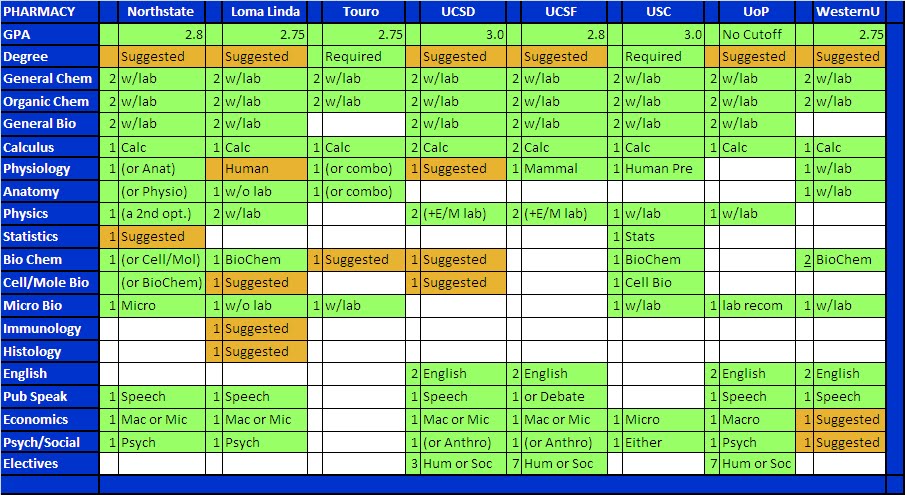
With the pharm tech step coming to a close, it's time to look to other things.  (Of course this look took place both before and after Thanksgiving with parents, siblings, cousins, aunts, uncles, and all sorts of family.  Not skipping the holidays to work on the blog. =P)  So I took a look at the prerequisites of all the schools in California and made this Excel sheet:


(Click to Enlarge - This is meant primarily for me.  If it's of use to other people that's fine.  Most of it should make sense though.  The numbers are the number of semesters needed for each class so if you want to schools with a quarter system, you'll have to make an adjustment.  Links to the official websites for each school are further down this post.  There is a lot of detail in each page that can't be communicated through the shorthand of my Excel sheet.)

If I recorded it all right, the classes needed to get into all California schools are:

- General Chemistry I & II (with labs)
- Organic Chemistry I & II (with labs)
- General Biology I & II (with labs)
- Physics I & II (with E/M Lab)
- Calculus I & II
- Statistics
- Human Physiology
- Anatomy
- Biochemistry
- Cell Biology
- Microbiology (with lab)
- English
- Speech
- Economics
- Psychology/Sociology

And besides classes:

- GPA
- Leadership
- Experience
- Community Service
- Letter of Recommendations

Something important I need to find out, is how old my course work is allowed to be before it's too old to be counted.  Northstate specifically said 9 years on their website, and UCSD says 10 years for some classes, and 5 years for essential classes.  That means besides retaking classes that I screwed up in, I'm most likely going to have to retake classes I did excellent in, because they're just too old.  That's a little discouraging.  But well... it's not totally unexpected.  That's the reason why I'm expecting to take two or three years to get there.  All I can do is move on from where I am, so that's what I'm going to do.

Something a bit annoying is that UoP requires micro economics, and USC requires macro economics, while all the others let you choose either.  Depending on how easy or difficult it is to fit taking all these prerequisites in while working... I may just have to choose between one or the other.  That's just something I'll have to figure out later when I have more info to work with.

California Northsate College of Pharmacy
This is the only website that specifically mentioned that work experience in a pharmacy setting of at least 40 hours is recommended.  It's also one of the two schools that mentions Statistics.

Loma Linda University School of Pharmacy
I found it pretty interesting that the Anatomy requirement didn't require a lab.  I didn't know Anatomy classes came that way.  But since I'll be taking the class with the lab, it doesn't matter beyond that.  And while I didn't see all the Letter of Recommendation requirements for all the schools, it's important to know that this school requires three, and one of those has to be from a Spiritual Advisor.

Touro University College of Pharmacy
This school has one of the sparsest requirements list.  It doesn't even require General Biology of Physics.  However having a degree is a requirement for applying which is why their website doesn't cover the non-science classes as prerequisites like the other schools do.

University of California, San Diego, Skaags School of Pharmacy and Pharmaceutical Sciences
One of the two schools that mentions that an Electricity and Magnetism Lab is required as part of the Physics prerequisites.  Makes me wonder what that's going to be used for exactly, when it comes to pharmacy.  Something to do with research is my safe guess.  Also one of the two schools that requires two courses in Calculus and not just one.  And last, the only school (that I saw) that mentioned CPR as a requirement. 

University of San Francisco School of Pharmacy
The other school that specifically mentions the E/M Lab as a prerequisite.  It's also the other school that requires two courses in Calculus.  Not much more to say.  I've been to an info session, I've been to the campus, I know I want to apply here, so I'll be sure to complete the list.

University of Southern California School of Pharmacy
The second school that requires a degree to apply.  The only school that specifically requires Human Physiology and not just some mammalian physiology.  Even more important, the only school that requires Statistics.  And the last unique bit that I found from my current outing through the schools websites, a Resume is required as part of the application process.

University of the Pacific Thomas J Long School of Pharmacy and Health Sciences
The only school that I know of that requires the GRE.  (I didn't find this info on the website, however, I found it on the pamphlet that was given at the info session.  Other schools may have this as a requirement.)

Western University of Health Sciences School of Pharmacy
The odd way I've marked the required semesters for BioChem is because you can take just one class of BioChem if it's 5 units, otherwise it's one 3 unit BioChem class and one 3 unit Molecular Biology class.

Saturday, November 21, 2009

UCSF Student Panel at SFSU - Part 2


[Continuing the conversation from the 2nd Year UCSF Student, at the event hosted by the Pre-Pharmacy Association... We left off with comments and questions about the interview process...]

-----

Q: Do they ask questions about current events?
A: Oh yes.  Yes they do.  If they make it through all the questions they needed to go through,  they'll ask something like, "What do you think about the future of pharmacy?"  If you think pharmacy is all community pharmacies, you need to be prepared to know it's moving away from that.

If you really want to be out there, you might want to say you're interested in MTM pharmacy.  Medical Therapy Management.  They can get paid hundreds of dollars for just a ten minute consult.  These days, a lot of the elderly are taking tens of pills in a day, and the schedule of what to take and when so it's effective and won't be dangerous is complicated.

Q: How is that different from community pharmacy?
A: There, they just give you a prescription, and you advise them about that specific drug.  With MTM pharmacy, you'll sit them down and go over their whole history.  That's something important in HIV clinics where there are just so many drugs out there.

Drugs are becoming very individualized and not just one blanket drug for one condition anymore.  There was this woman who was taking morphene for pain.  And because of her genetics, it got into her breast milk, and it ended up killing her baby.  [This is extremely paraphrased.]  Pharmacogenetics is the big thing now.  Hypertension, liver function... they affect different people in different ways.

Touro did a study... [This part... I'm not quite sure that I can even get the essence of it down.  Something about a study to help show that it's important for schools to teach pharmacogentics I believe.]  UCSF is one of the few schools to have that class.  People with different backgrounds need different drugs.  It's kind of like sterotyping, but not.  It's used to help them.

[Somehow what she did to become a pharm tech came up.]
A: Honestly, I bought a book at Borders, studied for a week, and passed.

Everyone should get their license.  It's a good back up.  Well, not back up exactly.  But some people became a tech to lead to pharmacy, but found out they were happy just being a tech.  A lot of the pharm techs that I work with know more than a lot of students.  They really know drugs.  It's like being a pharmacist without the responsibility.  (An aside: Insurance companies need a lot of pharmacists.)

Being a tech is easier to move between the different divisions.  When you're a pharmacist, you need to know everything about the particular place you're working in.  As a pharm tech, you only need to focus on the drugs, and so it's easier to make the switch if you want to get experience in the different areas.

And it's good to start learning the drugs early.  You learn a lot as a tech.  It helps a lot in school.  They want you to know over two hundred drugs right away, but if you've learned about a lot of them already, it gives you a lot of free time.

Pharmacists can work in so many areas.  Psych wards need to have a pharmacist on site.  There are classes to teach you about the different fields.  We have an elective for prison pharmacists.  You get taken to San Quentin and everything.

HIV is a disease with no cure.  You can specialize in that.  Genentech needs to hire pharmacists to look over projects.  You can oversee everything and not get your hands dirty if that's what you're looking for.  That's what I did at Bayer.

You can get into law and work for the government.  Healthcare is the big thing right now and they want the input from doctors and pharmacists.  [Something about laws that I can't read in my notes.]  Right now something being considered is making birth control and over the counter drug.  So many people are buying it, and there has been a study to show that the risk of death in using birthcontrol is lower than the risk of getting a lethal infection while a woman is pregnant.

Pharmacists are even the ones that administer euthanasia drugs.  It's in Nevada or some other state where it's legal.  Not in California of course.  But there, while the doctor may decide, it's the pharmacist that actually administers the drugs to stop the heart.

[Some how it got back to applications.]
A: You can check out PharmCAS right now if you want.  Just know that it gets wiped out every year.  As for letters of recommendation, most people get one academic letter, one extracurricular, and one from a pharmacist.

USC, UCSD, they had 500 word essays.  I pretty much just copy/pasted parts (from my UCSF application).  Essays are definitely the hardest part.

Q: Do you know any international students, and is the process any different?
A: It's pretty much the same thing.

[Somehow it back to why UCSF again.]
A: UCSF was the cheapest school.  Not now.  Tuition has gone up 30%.  $1000 every quarter.  It would be nice if somehow when you got accepted into a school, you could sign a contract telling you "This is exactly how much you're going to pay each quarter."

Q: How are you paying for school?
A: It's different for me.  I live with my parents, so housing is free.  Books can cost a lot.  I work at State (as an intern).  If you want to get involved, techs get paid the most in hospitals.  You learn the most about drugs there [I believe that's what she said, my notes were too hard to read right there.]

[She then mentions that she's working at a couple places.]  Twenty hours a week pretty much pays for each quarter.  I tried getting loans for the first year, but having to pay 7% on top of that was too much for me.

There are also a lot of scholarships out there. 

[Somehow changed to study/student habits.]
Some people are still completely focused on grades once they're in.  But once you graduate (from pharmacy school) grades don't matter.  If you're working as an intern while studying, you're more likely to get hired than if you got all A's.

[Back to money.]
Taking that year off, and working as a tech helped to offset the loans.

Q: What's your daily schedule like?
A: I'm a special case.  [Because she's working... then the answer transitioned into what classes are like.]  You really learn the drugs.  I can draw you lipitor.  Or the structure of cholesterol.  Then you'll be asked to make an imaginary drug that fits in there.  Some [other stuff] I learned through work.

[Change of topic again.]
In [some?] HIV clinics, the pharmacist will write the whole prescription now, and just hand it to a doctor to sign off on it.  They'll just take a look to double check.  Pharmacists have that dispensing power now.

[Back to the interview process.]
A: You might be asked to talk about a difficult problem you had to face, or a co-worker that was hard to work with.  Use names, and make it personal.  Make it so your answer isn't something that can be faked.

You need to prove you're not just a bookworm.

You'll all find a school.  There are so many schools out there.  Just the fact that you guys are all here says something.  I applied late, and I still got in.  You guys are doing so much more than me already.

[Transition to types of work.]
There are pharmacists that are temps.  They get sent around to different pharmacies that need work, and they get paid for food, gas, and travel time on top of the actual hours working.

Q: What were the most useful prerequisite classes?
A: OChem.  That leads to advanced OChem.  PCHem too.  Biology and all that.

There are some people who are 21 and they're pharmacists now.  They took all their prerequisites in one year out of high school and applied.

USC and UoP have the most prereqs.

If you get together and sets goals for each day, you can get through PharmCAS in a week.

Q: How long did it take you to write your personal statement?
A:  It took me a week.  I got down and just started writing every single step that led me to pharmacy, and it ended up being 6,000 words long.  The essay can't be more than 1,600 words.  So I asked one of my English professors to help me trim it down.  That was the teacher I also asked for a letter of recommendation.

One school requires a resume... UoP?

Make sure to do research one all the schools you're applying to.  Know what the goals of the school are and focus on that.  It's worth it to just apply everywhere.  It's just $40 more dollars for a chance to get into a pharmacy school.

----

There were some other random bits that I didn't write down, but I think I got pretty much all the main points.  There was a lot of interesting stuff in there, and new stuff that I hadn't heard before.

Prison pharmacist class?  That's cool.  I don't think I'd want to take that class specifically, but it makes me wonder what kind of other classes are offered.

Paying for school without loans?  That's impressive.

I'm definitely glad I went to the event.  And I hope you enjoyed reading about it.

Friday, November 20, 2009

UCSF Student Panel at SFSU - Part 1


The SFSU Pre-Pharmacy Association set up a UCSF student panel Wednesday night.  Well... set up a UCSF student for us to talk to.  One of the two could not show up for one reason or another.  Was that a problem?  Absolutely not.

The event was very relaxed.  We all sat in a circle, and just let questions fire away.  The student was a second year student, and she kept on firing out information left and right.  One question would just ignite all sorts of side tangents from her and there was a lot of information presented to us in the two and a half hours that she was there for.

I could try grouping all the information into relevant info clusters... but I'm probably going to be doing that a lot in future posts.  This time you guys'll get to enjoy the randomness that I got to enjoy.

-----

UCSF Student - Hi, my name is [keeping this out for privacy].  I'm a second year student.  Why don't we all sit in a circle.  If you like this kind of setting, the school in Sacramento is group oriented.  What's it called?  I think it's Northstate.  [Note: This whole thing is going to be paraphrased from my notes.  I'm going to try to be as accurate as possible of course, but this is not word for word.]

Why did I choose pharmacy?  I was originally a pre-med student, but I don't like bood, phlebotomy, the whole "do no harm" thing,... and gross mucus.

When you get into pharmacy, I thought you would get eased into it, but in the first month, you're already doing immunizations.  Flu, hepatitis.

Taking a year off was a big change, but it was a good change.  I was working in research/industry.

Pharmacy is a dynamic field.  You get to interact with other fields.  In clinics it's half research, half ___ [Me: Why can't I remember the word!  It should be so obvious].  There's management where you can run your own formulary.

What was the most difficult part?  Getting started on California applications.  It took a month to finish my applications.  (Her aside:  I used to work for Bayer, then had a job as a technician, and now intern at a clinic.)  UCSF has a good workshop for the supplemental application.  You get ask what it is they're looking for.  On the apps, a lot of it is monotonous work.  You could get your mom to do it.  Name, address, grades.  I also got last minute letters of recommendations.

For the interview, you get paired up with one professor and one student.  Make sure you know what you wrote on your application.  They choose who you interview with based on your application.  This isn't a fact, but from talking with other students, it seems like a lot of them were paired up that way.

Q: How do you answer the question "Why pharmacy?" without having it sound like a generic answer?
A: [I forget her full answer.]... look for some kind of personal story.  What got you to decide to pursue pharmacy, and not just "I like helping people."

[Continuing from before the question was asked.]  You get paired up that way so there is some common ground there for a flowing conversation.  There is a set number of questions they want to hit, but the order is different based off how the conversation is going.  [I thought that was interesting.]

Q: How did you prepare for you interview?
A: I got hired just a couple weeks before my interview as a pharm tech.  My boss did a mock interview with me.  Everyone should do a practice interview, even if it's just with family or a friend.  He really grilled me on what I know about pharmacy.  And when I went home he got me panicked enough that I did a lot of research on the website about what kinds of clubs and organizations they have, what conventions they're known for, etc.

Q: Why UCSF?
A: Basically I grew up here, and I wanted to stay close to home.  Then after already choosing that, I kept on hearing that it was basically the best school in the universe.  It's academically driven hospital so you'll get lots of clinical experience.  Lots of orgs on campus, and they got me really excited to join one.  Lots of social events.

Since SF has a lot of very distinct districts, there is a lot of opportunities for translational work if you know another language.  There is an HIV clinic on campus and you can shadow people.  If you want to get more into law and politics, Sacramento isn't that far away.  In the city there is some kind of heath fair almost every Saturday.

The P2/P3 students get to basically run the school.  There is a proctor that signs off on the liability forms, but we basically get to set up what we want.

Q: What other schools did you apply to?
A: Pretty much every school in California.  Do apply early.  UCSD has a fairly lenient application process.  They just have one essay.  Definitely have someone read over your essay and help you with grammatical stuff, etc.

To prep for your interview, know your own essay.  You don't want to write something on there that you don't really know much about and then get asked about it.

Q: How many questions are on the application?
A: It's a template.  Maybe nine questions, with a tiny box that you have to fit your answer into.  PharmCAS is the easy part.  Touro doesn't ask for your supplemental applications unless you pass the 1st tier of screenings.  You just have to do your research.  Some applications are electronic, and some have to be post marked by a certain date.  Those are scary.  That's why I just walked mine in.

Q: On questions about extracurricular activities, is it ok to write down random things?  Or should it all be pharmacy related?
A: It's better to be well rounded.

Some people say that if you're into research, you have a 50% better chance of getting accepted because there is just so much funding for research out there, and if you're into research they're hoping you'll stay on with UCSF after graduation and bring that money to the school, but that's not necessarily true.  Some people say you have to become a pharm tech before apply, but that's not necessary either.

UCSF has the least amount of prerequisites.  When I decided to go into pharmacy, I had 25 units to go, and I finished those in a year.  English classes, etc.  There's a link on the website which shows you all the equivalent courses.

I was interviewed late in the process.  I thought there wouldn't be much chance for me, but I got in.  It happens.  You hear stories about people getting the news.  One student was already in a school in Arizona, and was done with his first year.  He applied again to UCSF, got accepted and left the school.

Q: What's the on site essay like?
A: The on site essay is easy.  They questions are generally like "Rank these four things and [explain] why."  Just use common sense.  Choose the ethical reason over money.  They pretty much just want to see that you speak English.  You can't write on the back of the paper, or outside of the box.  Just one period outside of the line and you fail.  Don't write too much.  You can read more about what questions other people got on studentdoctor.net.  Communication, following directions, and having a moral conscience.  It seems like that's what they want to see.

If you have bad grades, don't bring it up.  They don't have access to transcripts.  Emphasize stuff like involvement in other things and community service.

Q: What about the question that's asking something about the "human condition?"
A [A lot of people chimed in on this, and came to a consensus that the question is purposefully vague.]

-----

And I think I'll cut it off right there.  I'm not even close to halfway through my notes.  There was essentially no silence for the two and half hours that the UCSF student was there.  Come back for Part 2!

Saturday, October 24, 2009

UCSF Pharmacy Day (Hosted by CSHSP)


Back to UCSF already. This time it was much easier to get there, and easy to find the HSW building. There were even some convenient signs pointing the way, even though I already pretty much knew how to get there.


-- Free Health Screenings (Diabetes, Cholesterol, and Hypertension)

The diabetes table was open, so I went there first. I was going to get tested for all of it, so it didn't matter which went first. I guessed I was currently at a low risk for diabetes even though my dad has diabetes, and after answering a series of questions, the student pharmacist confirmed my guess. After signing the consent form, my finger was pricked, and test confirmed it even more. Unfortunately I left the info sheet that my result was written on, so I no longer know the specific number.

Next was the Cholesterol test. Consent and finger number two was pricked. I was told that this test would require a bit more blood than the diabetes test... and then my finger stopped cooperating! Barely any blood came out, she tried to massage some blood out and it didn't help. I was then asked to stand up and that didn't work. So it was time to band-aid it up and prick finger number three with a bigger needle. It worked and my finger bled.

While we waited for the machine to spit out the results, the student pharmacist took my blood pressure. 131/80 came out. Right in the middle of the pre-hypertension range. Good to know. The accompanying info sheet suggests taking my blood pressure every month, and I may just do that. Then came the cholesterol results... 195! That's too close to the 200 border that keeps me in the desirable range. Last year when I donated blood with the Blood Centers of the Pacific, I was informed that my blood type was O positive, and that my cholesterol was 171. Even if eating breakfast brought up my results today, it's still probably higher than it was last year, and it's higher than I want regardless.

With the tests done, I went back out into the lobby where some food (muffins, croissants, juice, coffee, and water) were served, as well as some project posters. The most interesting fact from the men's health poster was pointed out to me by the student pharmacist in charge of the project. Testicular cancer most likely occurs in males between 15 and 34. That means me! On that table was a model scrotum to feel what a tumor would feel like. I picked up some pamphlets on Alzheimer’s disease at the mental disorders project. Possibly useful since my grandfather had it, my dad might get it, and I could get it as well. And there was a fun little Myth/Fact game at the anti-bacterial project. I got four of the five questions right and got a nice little bag of swag.


Viral Pak Contents: Info Pamphlet, Tissue,
Hand Sanitizer, Tylenol, Green Tea x2


-- Senator Leland Yee on Healthcare

The second half of the event was a speech and Q&A session from Senator Leland Yee of the California Senate on the subject of healthcare. I'd say it was a pretty good speech. Opened up with saying that coming to SF feels like coming home, and why healthcare is important. And how he votes the way he believes.

To summarize, there were three main concepts he felt were important to healthcare.

1) Preventative health care will greatly reduce costs and is very important. Sometimes it would be better if people couldn't refuse some treatments because their refusal causes further problems down the line for the patient and/or society. (Ex. Someone with a mental disorder refuses to take any medication, and may end up causing some sort of harm to other people and/or ends up with worse health problems because of that decision.)

2) A connection between health professionals and patients is important. (And of course he mentioned how pharmacists are ranked as the number one trusted health professional and we should keep that up.)

3) Money is a strong force in the healthcare industry and a public option is necessary to keep things honest.

Points two and three seem to make sense. Point one makes sense in a general sense, but of course when it comes to imposing on individual rights, there is always some concern. The details are important for all points of course.

The senator ended with saying that he believes that while heathcare will pass on the national level, there will be some important things left out because of how our system works, and the issue will then return to the state's to take the issue all the way. And he added that it is important that we all speak up and have our voices heard.

Then the Q&A Session (Short form):

Q: The public option may not pass on the national level. Is it a slam dunk for California?
A: Depends on the costs.

Q: What kind of stats are there?
A: About 25% of Californians don't have health insurance.

Q: Pre-existing conditions?
A: That's a complicated cost issue. Insurance is obviously opposed to it because it will no doubt cost them money. In the Doctor's PoV they need to be able to be treated.

Q: Speaking of preventative health care and fiscal responsibility, Will we be watching the overall health of the population?
A: That is a good question that hasn't been brought up. In short, no. We're only focusing on ways to finance healthcare, and that people who are sick have access to treatment. That is a good point that should be in our agendas.

Q: Have you considered a Kaiser type of public option?
A: Kaiser has been involved, but details such as who will control that particular system (solely the non-profit, or with government oversight) and other details must be considered. There are a lot of good points to that system, but some bad as well.


-- Conclusion

I thought the event was great.  Everyone was friendly, I got a lot of useful info.  I talked to several of them about how they're liking their classes so far, and everyone was encouraging about pursuing a career in pharmacy.  One of them even gave me her email in case I ever have any questions.  All in all, it was well worth it to attend.  Who knows, perhaps I'll be helping out at an event like this one day.

Saturday, October 10, 2009

Reports from the Pharm... and even more links

It's going to take a while to check out all the links in the list of 50 pharmacist blogs (and the links that those pages suggest), but I've scanned a couple, and added more direct links to them on the right right.  Jim Plagakis and The Pharmacy Chick both seem to be good blogs that are still frequently updated.  (Not all of the blogs on that list are.)  I've also added the new section for Pharmacy News & Info Blogs, putting up Pharmacist Daily, PRIME - Pharmacist Cast Studies, and Bioethics.net

All of those blogs seem helpful in getting better insight into what a career in pharmacy will be like.  (A little frightening that a lot of the titles of those blogs on the list deal with a lot of anger and frustration, but I think that tends to be the nature of blogging.  Angry blogging can be entertaining blogging.  I'm sure there are plenty of happy pharmacists out there.)  Jim Plagakis and The Pharmacy Chick don't seem to be all that bad, upon initial scan, which is why they made my list.  For now I'll just stick to having one angry pharmacist, and try to keep my reading more balanced.


As for another blog that deals with more immediate concerns for myself, Reports from the Pharm is written by Joel Gonzalez, Admissions Director of UCSF.  He mentioned his blog during the UCSF Preview Day, and that mention is what got me to start looking up other pharmacy blogs. (Yeah I know, you'd think that actually writing a blog would have gotten me to look up other blogs.  *shrugs*)

While not nearly as frequently updated as Pharmacy School Admissions, there is still a lot of great info within the few posts that it does have.  Tips for a successful applicant, tips to prepare for their interview process, and the importance of their supplemental application as well as some other insights.  The blog is funny and useful, and it's easy to get through every entry.  Definitely worth checking out.

Wednesday, October 7, 2009

UCSF Preview Day - Part 5 - Campus and Conclusion

After the official presentation was over, we were given a campus tour.  Here are just a couple pics:


A portion of the map that was emailed to me,
for reference. (Click to enlarge)


The School of Nursing where the presentation took place.


Health Sciences West where most classes will take place.


Parnasus runs right through the campus.  In front is the
bookstore/cafeteria/gym.  The library is on this side as well.


A small glimpse at one of the classrooms.


Here is a side shot of that same classroom
from the center aisle for a better idea of its size.


The prettiest shot. The courtyard between the
School of Nursing and Health Sciences West


We also saw the computer lab, but it was filled with a bunch of student pharmacists in the middle of studying, and I didn't want to take a picture of them without permission, and I did not want to disturb them, more than we already were.  The room was big and spacious however.

We were also shown a break room, which I was told almost no one ever uses, except for the mail boxes, fax machine, etc.

Overall, the campus feels very San Francisco.  The building themselves are somewhat maze like and will take some getting used to.  However, if you don't like the food the school offers, which I was told was pretty good, their are tons of food places the next street over on Irving.

As for my impressions about the whole presentation.  I left with a sense of hope.  It's going to take work before I can get into any pharmacy school, but the reassurance that grades are only one aspect of many that the admissions officers consider was great to hear.  The program itself sounded great, the health policy and management pathway caught my eye.  UCSF is definitely a school that I would want to attend.