Sunday, October 4, 2009

UCSF Preview Day - Part 3 - Admissions


Time to get into what it takes to become a pharmacy student (or as they refer to themselves, student pharmacists) at UCSF.

First, some fast facts:

- UCSF admitted precisely 122 students for the last term.
- 6 of those students came from the waitlist. (One of those students was driving on his way to a school in a different state when he got the call, and turned around.)
- The deadline for the application is November 2nd, eastern standard time. (But San Francisco is in the PST time zone? Weird. I know.)
- PCAT will not help you whatsoever. The admissions director claimed that he doesn't even know the meaning of the numbers as presented on the PharmCAS.
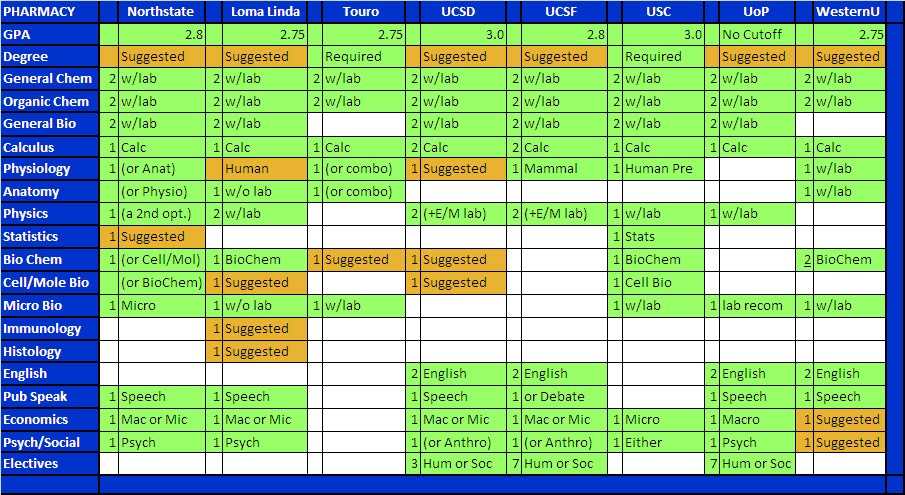
- Minimum GPA required as calculated by PharmCAS: 2.8
- The GPA of the previous class ranged from 2.96-3.97. Many 4.00 students applied, but they did not have the characteristics that they were looking for.
- You must complete and submit the PharmCAS and the Supplemental Application. Unlike some other schools, you are not supposed to wait for an invitation to turn in the Supplemental Application. You turn in both at before the deadline.


Some info specifically related to the Supplemental Application:

- It is available mid-July
- $$60 fee for domestic students, $80 for international students.
- No preference for submitting it early.
- It is suggested to take your time to make it as good as possible, but at the same time turn it in early enough so that if there is something wrong with it, it can be sent back and fixed to be resubmitted.
- If a student has to be denied, they would prefer the denial be based off of the application, and not a technicality, and will do their best to make sure that doesn't happen.
- Suggested date to turn in an application is October 1st.


More fast facts:

- Over 1,600 applicants this past cycle.
- About 200 more applicants apply every year.
- 275 were invited to an interview (17.2%)
- Once again, 122 accepted. (44.4% of those interviewed)
- 99% had a bachelor's degree
- 3.55 average GPA
- 3.47 average GPA


Admissions Timeline:

- June 1 - PharmCAS available
- Mid-July - Supplemental Application Available
- Nov 2 - Application Deadline
- Nov/Dec - Initial review
- Dec/Jan - notify 95% of potential students to be interviewed
- End of Jan - Interviews begin
- Jan/Feb - Interviews conducted in SF
- Feb/March - Admission Committee review
- April - Decisions mailed


Admissions Beyond the Numbers

- UCSF wants to prepare students be become leaders in pharmacy
- GPA is only one factor (This is something that was repeated in various forms multiple times throughout the presentation.)
- Other important factors include: Communication skills, Leadership potential, Community service, and Health Care experience


USCF is looking for:

- Strong and detailed letters of recommendation
- Detailed biographical information
- Well written and thought provoking statements
- A confident interview and good interview essay
- Demonstration of personal motivation through: Community service and volunteer work, a knowledge of pharmacy and health care, and excellent communication skills.


Discussion points:

1) Preparation begins now
2) Select individuals to write letters of recommendation
3) Take time to prepare your essay
4) Be able to communication what you will be able to add to the class and to the program
5) Make sure your application looks professional. Double check for spelling and grammar. Mistakes demonstrate a lack of attention to detail.
6) Know how to answer the question "Why pharmacy?"
7) Q: What if my GPA is below average? A: If you take one thing from this presentation remember that GPA is only one thing we look at. Focus on the things that you have control over.
8) Q: Do I have to be a biology, chemistry, or biochemistry major? A: No.
9) Q: What about extenuating circumstances? A: The application is very detailed. We take a holistic view of the application.
10) Have some experience in pharmacy or health care.
11) If invited, prepare for interviews!


You can read the admissions blog at pharmdadmission.ucsf.edu. It contains helpful hints, funny stories, and an insider's view.


Back to the GPA issue

I can't stress enough how many times it was said that GPA is only one factor, our admission process just doesn't work that way, we take a holistic view of the application, etc. It was mentioned, in various ways, ten or so times over the course of the one hour and twenty minutes before the student panel began.

He really wanted to make sure that it was understood that GPA alone does not make a good candidate. There is much more to a student than just that. Coming away from the presentation, I definitely left with more hope about being able to get into pharmacy school.

Saturday, October 3, 2009

UCSF Preview Day - Part 2 - School & Program


There was a lot of information thrown out at us during the presentation, and it started off talking about some nice bullet points about the school.

- UCSF is unique among the other UC's in that it is only a graduate school, and is devoted solely to the health professions.
- 38.000 students in dentistry, nursing, medicine, pharmacy, physical therapy, and a graduate division.
- UCSF medical center is ranked in the top 10 of teaching hospitals in the US.
- The Pharmacy school is ranked #1 in the nation. (Although he did mention that number one in the nation doesn't mean number one for every single individual, and understands that some people may choose differently according to their own needs.)
- First PharmD was given in 1958
- Clinical Pharmacy was born here in 1966
- 65% of student pursue a residency program (Other schools tend to have a much smaller percentage)


A cool fact: When people call the California Poison Control System to get advice about someone ingesting one poison or another, the calls are taken by pharmacists at UCSF, because they are the ones that run the program.

The program is labeled as s four year program... sort of. I am only familiar with semester schools systems, but what was said was that for the people who are familiar with quarter school systems, the program ends with the winter quarter of the fourth year, so the program is actually more like three and a half years.

The current curriculum was introduced in 1998, which means fairly recent, and on top of that they are constantly updating the program based on the advice and feedback from the students.


Now for the curriculum for itself:

- Flexibility to pursue career interests via pathways
- Peer and collaborative learning
- Emphasis on communication and presentation skills (As an aside: It was said that they denied more people based off of communication issues rather than below average GPAs)
- Early exposure to practical issues
- Integration of basic science and clinical application (case-based problem solving)
- Capstone project required of all students (Not even close to a doctoral dissertation or a senior thesis, but it is required.)


About the Pathways

- It is somewhat like a minor
- In your first year everyone takes a class that is an introduction to the pathways
- The pathways are: Pharmaceutical Care, Pharmaceutical Health Policy and Management, and Pharmaceutical Sciences
- Pharmaceutical Care is the more traditional route. Most people choose this.
- Pharmaceutical Health Policy and Management is more population based and not individual based. The emphasis is on health policy, phamacoeconomics, outcomes research (did I type that right?), and application of management techniques
- Pharmaceutical Science is designed to develop skills required for clinical and basic sciences research. There is an emphasis on clinical and pre-clinical research, regulatory affairs, and research administration.
- For more information on the pathways, go here.


About Rotations:

- Rotations are centered around 6 different areas. San Francisco, the South Bay, the North Bay, Davis, Fresno, and the LA/Orange County area.
- Students are placed in one area and do all their rotations there.
- The place you go to is chosen by a lottery. Students rank the areas they want to go to. Students usually get their first or second choice.
- If there is a unique rotation in an area that the student isn't in that they really want to take, arrangements will be made.
- Some students may get exemptions as decided by the student leadership.


That's about it for the quick breakdown of the school and program. More information can of course be found at their website pharmacy.ucsf.edu.

Friday, October 2, 2009

UCSF Preview Day - Part 1 - Overview


My first blog post about my trip to UoP wasn’t thorough enough to really break down all the information. This time I’m going to break down my experience going to the University of California, San Francisco into several parts, starting with a quick overview.

The first thing of note is that this was a short two hour presentation. UCSF has about one a month. The longer, full day experience is held in SF, LA, and Fresno, but only in the Spring. When May 22, 2010 comes around, I’ll be there to check out the full length experience. (For info on all three Information Days, go here.)

Getting there wasn’t too much trouble. I received an email a few days ago reminding me about the event, including telling me the time and building to go to, as well as including a PDF of the campus map with a big red arrow pointing to where I was supposed to be. I left later than intended, but since I intended to get there more than half an hour early, I still arrived with plenty of time to find the place, and I even lucked out and found good street parking and didn’t need to use the garage.

The campus itself is a bit maze-like, and it did take some effort to figure out how to get to the Nursing Building where the presentation was to take place, because the entrance to that particular building wasn’t along the main road. (The road Parnasus cuts right through the campus with a lot of the buildings facing that street.) Once I found the building, the room itself was no problem to find.

When I took my seat, I was approached by someone who asked for my name, and after confirming that I signed up for the event, handed me a folder filled with all sorts of useful information:

- Program & Admission Facts Sheet
- Doctor of Pharmacy Curriculum Sheet
- PharmCAS Index Card
- UCSF School of Pharmacy Brochure
- UCSF’s Pharmacy, Nursing, and Medicine Rank web printout
- A Pharmacy Today pharmacist profile web printout from pharmacytoday.org (March 2009, pg 32)

The presentation started on time and was broken down into two parts. The first part was headed by the Admissions Director, Joel Gonzalez (I hope I spelled his name right.) and he covered a whole range of topics including what makes UCSF so special, the uniqueness of their curriculum, and admissions information. The second part was a Q&A session with three students. A 1st year, 2nd year, and 3rd year.

After the two hour presentation, some people left, and those that stayed broke down into three smaller groups and we had a small tour of the important areas of the campus.

And that was it. At about 5:30 the tour was over and I left. Part 2 will delve a bit more into the details of what went on.