Monday, November 30, 2009

Not as Big of a Hurdle - My GPA


Ok, so I went to PharmCAS and created an account.  Then I sadly found out that they don't calculate your GPA on the spot.  You enter in all your classes, fill out the rest of the application, send them your transcripts and payment, and then after five weeks they'll tell you your GPA.  So the plan to use PharmCAS to calculate my GPA was a bust.

But...

What I did find was the FAQ on how PharmCAS calculates GPA.

They use semester units (and convert quarter units to semester units by multiplying them by .667), which is great, because I've only been to colleges on the sysmester system.

They use the 4.0 scale, counting pluses, minuses, and grades like AB, BC, etc.  (There is also a conversion for number only grades.  (Ex. 3.79-3.6 = A-)

- 4.0 = A+/A
- 3.7 = A-
- 3.5 = AB
- 3.3 = B+
- 3.0 = B
- etc.

And finally, classes that are not counted in the GPA include: withdrawn courses, incomplete courses, audited courses, pass/fail courses, non-graded transcripts, AP/IB/CLEP courses, planned courses, in-progress courses, deferred courses, and institutionhal/departmental exam credit.  (There are of course other rules, but there are the main ones for me.)

So as long as I entered in the data correctly into my Excel sheet, and understand the FAQ right, because of how they treat incompletes, I have a 2.85 GPA rather than the 2.71 that SFSU is telling me.

That helps.

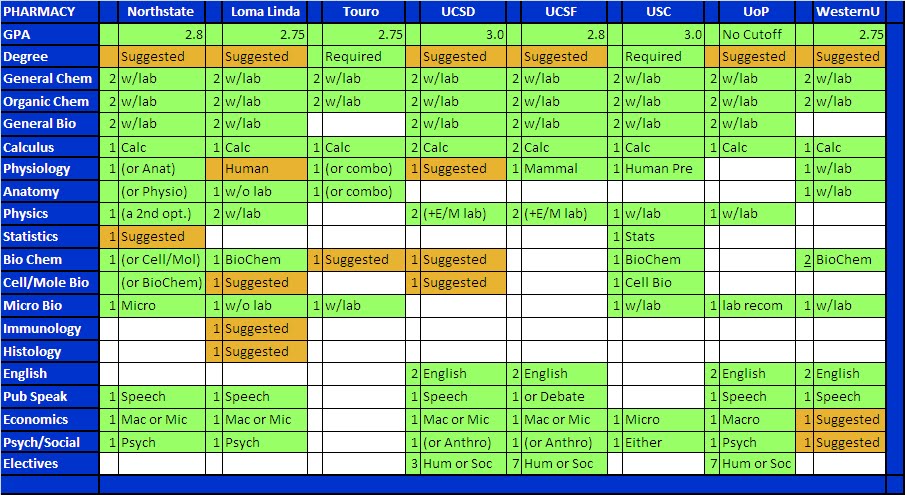
I'm now at the minimum GPA to get into all the California Schools except for UCSD and USC.  The minimum isn't good enough if I haven't demonstrated that I can handle the course load, but it is one less thing that I have to worry about.

The benefit of creating my own Excel sheet is that I can project what future grades will do for my GPA.  And because I have so many units, it will take 39 units of all A's to raise my GPA to a 3.0.  It's possible, but difficult, to do in the time frame that I want.  I'll have to seek out more information about any kind of exceptions.

However, with this new information, it is much more important for me to figure out exactly which classes I need to take (or retake):

- To satisfy a prerequisite
- To demonstrate I can handle the course load
- Because I performed poorly in them
- Because they were taken too long ago

I think tackling that list will take care of my GPA problem.  GPA is now a side effect of the course work issue.  I need to come up with a list, figure out when and where I'm going to take these classes, and then execute that new plan.  As long as I can get into and have time for the classes needed, I expect to get A's.

With this new information, I am now looking to apply in two application cycles.  The two to three years that was in my head has now settled down to one choice.

P.S.  I still have to check out my Prerequisite/Science GPA.

Sunday, November 29, 2009

PSAR (Pharmacy School Admission Requirements)


I was looking through the stats section of Get Into Pharmacy School: Rx for Success!, and despite it being printed just this year, I noticed that some of the info (specifically the tuition for UCSF) was already out of date.  But thankfully the chapter "Planning Your Undergraduate Experience" led me to a more accurate source, the AACP website, and more specifically to the page on the PSAR

The Pharmacy School Admission Requirements (PSAR)© is designed to provide the most up-to-date information about each pharmacy school, including specifics about admission requirements, selection factors and educational costs for students entering pharmacy school in fall 2010. [ISBN 978-0-9723236-5-9]. To order a printed copy of the Pharmacy School Admissions Requirements©, go to the AACP Order Form. The PSAR is $25 plus $3 for shipping and handling.

Links to all the forms in .pdf format is all there ready for you to print out if you don't want to pay the $25 fee.  I'm going to go even further than that.  Since I'm just looking at the California schools right now, and the tables clump the schools by state... I'm going to be doing some copy/pasting into Paint, and do some quick photo editing so I get only the info I need, and save on ink.

(FYI: Hit the "Prt Sc" [Print Screen] button on you computer to copy what's on your screen.  Then you can just do the normal Paste.)


- The tables of interest to me are:

PSAR Table 1: Pharm.D. Programs - Pharm.D. Degree Programs Anticipated for 2010-11.
PSAR Table 3: Graduate Programs - Institutional Information and Graduate Degree Programs Anticipated for 2010-11
PSAR Table 4: Dual-Degrees - Dual-Degree Programs Anticipated for 2010-11
PSAR Table 8: First Year Pharm.D. Class - Characteristics of fall 2008 First Year Class for Pharm.D. Degree Programs
PSAR Table 9: Admissions Policies - Admission Policies and Practices for Pharm.D. Degree Programs Anticipated for 2010-11
PSAR Table 11: Tuition - First Year Tuition and Fees for Pharm.D. Degree Programs in 2009-10


- Now the real find is this next link.  The tables may be good for comparing schools in specific categories, but this next link gives you a full view of each individual school.  You get paragraphs about the school, its mission/vision, what the curriculum is like, admissions requirements, as well as all in the info in the tables.  And this won't even take any photo editing, since each school is given their own two pages.  Just pick and choose.

School Admission Requirements - Two-page narrative that includes General Information, Curriculum, Admission Requirements, and Further Information for each AACP member institution


- This last link gives a nice break down of all the prerequisite courses.  I like the table that I made for myself, but I'll be using this to double check that my info is correct.

Course Prerequisites by Pharmacy School - Summary of pre-professional course requirements by pharmacy degree institution

Saturday, November 28, 2009

Major Hurdle - My GPA


Ok, it's time to give it up. I've been skirting around this subject.  My GPA is 2.71.  I have a total of 283.5 units.  (I've been in school a long time.)  That's a lot of units.  That makes it hard to raise my GPA.  Most of the California schools require a 2.75 or 2.80 minimum GPA, with USC requiring 3.0.  And of course most of the time people with just the minimum GPA don't get in, so I want to raise my GPA as high as possible.

As soon as I get a pharm tech job, I am aiming to work full time until I get into pharmacy school.  That might limit my ability to take enough classes to raise my GPA to above a 3.0 in the next two/three years.  If possible, I would like to take at least one semester as a full time student with a full and challenging class load, as further proof that I can handle the challenges as a pharmacy student.  (The UoP admissions people mentioned that it does not look favorably if only one or two classes are taken at a time, and should be avoided if at all possible.)

I have a low GPA, a lot of units, and will (hopefully) have a full time job as a pharm tech. Those circumstances create a major hurdle in acquiring a qualifying GPA, let alone a competitive GPA.

I haven't crunched the numbers yet, but I took five classes last semester, got two A's and three A-'s.  That rose my GPA from 2.65 to 2.71.  With that rough estimate, It seems that making it to a 2.8 is possible in the time frame that I want.  3.0... not so much.  When I go down to the USC Info Session, most likely on this upcoming January 15th, I'll be sure to ask if there are any exceptions to the 3.0 rule.  (I know one of the websites specifically stated that some requirements could be waived if there was a good enough reason.  However I can't seem to find it at the moment.)

I'll be entering my grades into PharmCAS in the near future, just to see how it calculates my GPA compared to how SFState does it.  PharmCAS is the one that matters.